When the power goes off, what has to stay on?
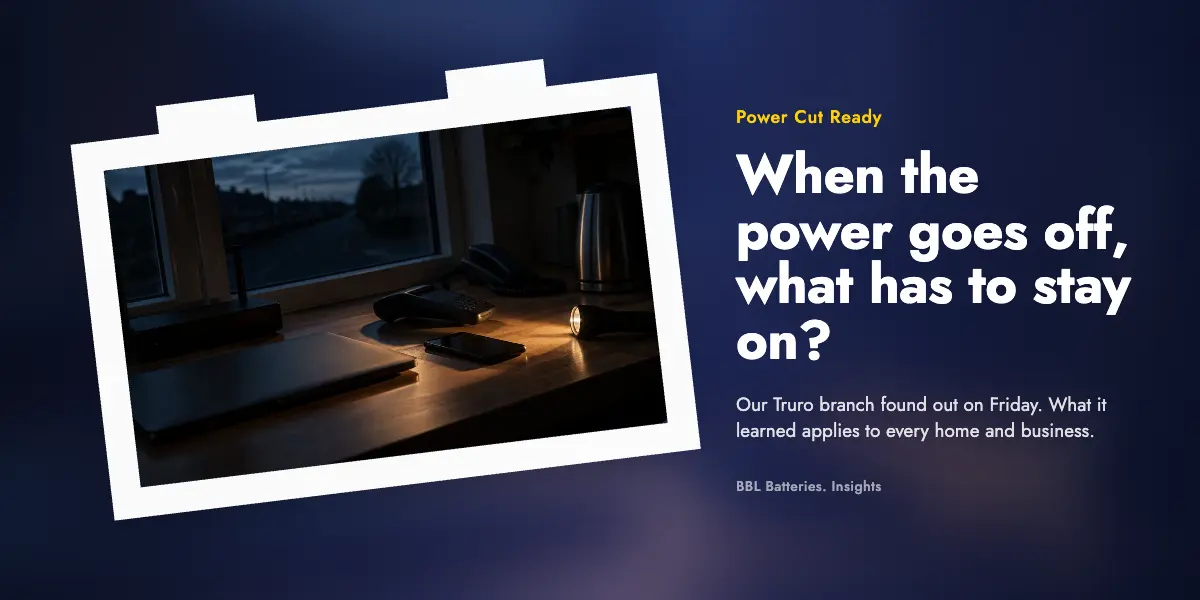
At 9am on Friday 23 October, as Storm Austen came through Cornwall under an amber wind warning, the power went off at our Truro branch. It came back at 12.30pm. In between, the branch took payments, answered the phone and served customers, because the team connected a battery and an inverter from the shelf and plugged in the four things that mattered.
Nothing about that is special to a battery shop. Swap the counter for a kitchen table, a farm office or a desk in a spare room and the morning plays out the same way. A handful of things really matter. Most things can wait. The difference between a nuisance and a bad day is whether you worked out which was which before the lights went.
Austen won’t be the last named storm this winter, and the government is now asking every household to be ready for exactly this. Here is what Friday taught us, and how to apply it where you are.
- 9.00am
- Mains off, Storm Austen, Friday 23 October
- 12.30pm
- Mains back
- <150 W
- Computer, card machine, two phones and the router, together
- 37 h
- Run time left on the battery app when the power returned
The list is shorter than you think
When the branch went dark the team didn’t try to run the building. They ran a computer, a card machine, two phones and the broadband router. Together those drew well under 150 watts, less than a single bar of an electric fire. The lights stayed off; daylight was enough.
That is the most useful thing to take from Friday. Ask what would actually stop you if the power were off for a day, not what would be inconvenient, and the answer is usually four or five items.
- Staying in touchPhones and the broadband router. Without the router most homes have no landline, and mobile signal indoors is often poor. For a business, the router is also the card machine, the booking system and the email.
- Taking moneyA till and a card terminal draw very little. A morning with the door shut costs far more than the parts that would have kept it open.
- FoodThis one is about discipline, not power. A full, unopened freezer holds safe temperatures for around 48 hours; half full, about 24. A fridge is safe for about four hours. Keep the doors shut and don’t plan on running either from a battery; a fridge is one of the heavy loads below.
- HealthOxygen concentrators, CPAP machines, stairlifts, hoists, powered wheelchairs, fridge-stored medicines and the chargers for all of them. If anyone depends on one, it goes to the top of the list, and your electricity network operator’s Priority Services Register should have your name.
- Warmth and lightMost gas boilers stop without electricity because the pump, fan and controls need it. A torch, a head torch and a radio cover light and news, which is what the official advice asks for.
- WorkIf you work from home, the laptop and router are your income. A farm adds livestock water pumps and a fence energiser. A campervan owner already has most of the answer parked outside.
Save stored power for the short list
Someone in Truro connected a second battery to run the microwave. It worked, and it drained far faster than everything else together. A microwave takes four or five times the power of the computer, phones and router combined, and a kettle three times more again. Heating, cooking and refrigeration are the heavy loads in any building, and a kettle will empty a battery that would have run your phones and router for a day. Use gas, use a camping stove outdoors, keep the fridge shut, or wait.
Two smaller lessons. Switch the inverter off when nothing is plugged into it; a large inverter uses power just being on. And pick the smallest inverter that covers your biggest load. Bigger isn’t safer, it just wastes energy idling.
37 hours, at that load
The battery Truro used has an app that estimates run time from what you are drawing. When the mains came back at 12.30pm it was showing 37 hours left. Plug in more and the number falls; plug in less and it climbs.
Nobody honest will quote you “x hours” without knowing what you intend to run.
Watts × hours ÷ 10 = amp hours at 12 volts
The ÷ 10 includes a sensible allowance for the inverter.
A router, a couple of phones and a laptop at around 100 watts for 24 hours is 2,400 watt hours, so a battery of about 240 amp hours.
A kettle at 3,000 watts for ten minutes is 500 watt hours, about 50 amp hours, gone in the time it takes to make two cups of tea. Add your items up, leave the heavy ones off, and the right size falls out.
Truro had daylight. Most cuts don’t.
The branch never had to think about light. At 9pm in January it would have been the first problem, before the router and the card machine. The good news is that light is the cheapest thing on the list to solve, and the most dangerous to improvise.
Candles start house fires every winter, which is why the official advice says torches are safer. A modern LED lamp or lantern draws a few watts; a 10 watt LED bulb running all night takes about a tenth of what Truro’s computer, phones and router used. A battery and inverter sized for your short list will run two or three lamps for days without noticing. Rechargeable lanterns and head torches do the same job without an inverter at all, and a head torch leaves both hands free for the fuse box, the dog or a child.
Night is also when warmth and health matter most. If the boiler is on your list, that is a job for an electrician, so plan the fallback now: one room, closed doors, blankets, a hot water bottle filled from a gas hob or a camping stove outdoors. CPAP and oxygen users should size for a full night, not a few hours. And most burglar alarm panels carry a backup battery for several hours but not a whole night, so expect a chirp at some point and know where the code is.
- By the bedA head torch each. The first thirty seconds of a night-time cut are the ones people fall down stairs in.
- In the kitchen drawerA lantern that stands up and lights the room, not a torch you have to hold.
- By the fuse boxA torch and the network operator’s number, 105, written on paper.
- On chargePower banks and rechargeable torches kept topped up. A flat torch is a candle you haven’t lit yet.
- Spare batteriesIn the sizes your torches and radio actually take, in the same drawer.
Three days of supplies. Power isn’t on the list.
The Household Emergency Plan at gov.uk/prepare asks every household for three days of supplies: bottled water, food that needs no cooking, a torch and spare batteries, a battery or wind-up radio for updates during a power cut, and a power bank for your phone and any medical devices. It also suggests writing the plan down, because you won’t have the internet to look it up.
Backup power for the building isn’t on the government list. It is the question we have been asked most this week, so here is a plain answer from people who sell batteries for a living.
Three questions decide what you need
- What has to stay on?Your short list from above. Be honest about it; the router matters more than the television.
- For how long?A few hours, a day, or two or three days. Beyond a day you usually need a way to put power back in, which is where a folding solar panel comes in.
- Where would it live?A battery and inverter take about the space of a large toolbox and want somewhere dry, frost-free and ventilated, which can be indoors. A folding solar panel needs a window, a yard or a bonnet.
Answer those three and the rest is matching parts, which is a job for someone who does it every day.
Straight answers
Is this a generator?
No. There’s no engine, no fuel, no fumes and no noise, so it can live indoors. A battery stores power and an inverter turns it into the 230 volts your plugs expect. You charge the battery from the mains before a cut, or from a solar panel during one.
Do I need an electrician?
Not for a stand-alone setup like the one Truro used, where appliances plug into the inverter’s own sockets. Anything connected to the building’s wiring, including a boiler, is a job for a qualified electrician, and an inverter must never be plugged into a wall socket to “feed the house”. We’re battery specialists, not electricians, so if you’re in any doubt, ask a qualified electrician; we’ll happily talk you through the battery side in branch.
Does the type of inverter matter?
Yes, more than the brand. A pure sine wave inverter produces the same smooth power as the grid. A cheaper modified sine wave inverter is fine for a simple lamp or a kettle, but it can overheat or damage anything with a charger or sensitive electronics, and medical equipment makers generally specify pure sine. If your list has a laptop, a router or a medical device on it, buy pure sine.
Will a solar panel run my house?
No, and be wary of anyone who says otherwise. A folding panel in a window or a yard puts enough back into a battery over a UK day to keep phones, a router and lights going. It will not run a fridge, a kettle, an oven or a heater, and on a grey December afternoon it will do far less than the number printed on the box.
Why lithium rather than the leisure battery I already have?
If you already own a leisure battery and an inverter, that will get you through an evening. A lithium iron phosphate battery gives you roughly twice the usable energy for the same size, weighs half as much, holds its charge for months on a shelf, and shows you what is left in an app. If you are buying for this purpose, lithium is the sensible choice. One thing to know: most lithium batteries won’t accept a charge below freezing. That is a protection, not a fault, and another reason to keep it indoors.
Does it need a special charger?
Yes. Lithium batteries need a charger with a lithium setting; an old lead-acid charger won’t fill it properly. Charge it after you buy it, top it up every few months, and it will be ready when you need it.
I’m on oxygen, or I care for someone who is. What should I do?
Tell your electricity network operator so you are on the Priority Services Register; they will contact you in a cut and can prioritise your area. Then find out how much power the device draws. An oxygen concentrator typically uses several hundred watts all night; a CPAP machine without its heated humidifier uses a fraction of that. That one number decides the battery you need, and it is the first thing we will ask.
We’re rural and lose power a few times a winter. Is this worth it?
That is exactly who this is for. A modest battery and inverter that keeps the router, the phones and a lamp going turns a bad evening into an ordinary one, and the same kit goes camping in the summer.
We’re a business. Where do we start?
The same three questions, with one addition: what does an hour with the door shut cost you? For most shops, cafes, salons and small offices the answer is more than the parts that would keep the card machine and router alive, which is why the Truro branch had them on the shelf in the first place.
Can I just buy what Truro used?
You could, but it would be more than most homes need and less than some businesses need. Tell us what you want to keep on and for how long and we will size it for you, with a bundle deal when you buy the parts together.
Write your short list. We’ll size the rest.
It takes five minutes and it is the one thing you cannot do once the power is off. Then answer four questions and your nearest branch will come back within one working day with a price for what fits your home or business, not somebody else’s.
Or call 0808 168 0635 and talk it through with a person.
Bristol, Truro, Swindon, Plymouth and Exeter.
This article is general information from a battery retailer, not professional advice; if in doubt about any electrical installation, consult a qualified electrician. Run time is quoted as the battery app reported it at the Truro branch’s load on Friday 23 October 2026, during Storm Austen. Battery backup is for low-draw essentials; it is not a practical way to run fridges, kettles, cookers or heaters. Your load will differ and no run time is guaranteed. Food safety times are the Food Standards Agency’s general guidance for unopened appliances. Official preparedness advice is published by HM Government at gov.uk/prepare; BBL Batteries is not affiliated with it. To report a power cut in England, Scotland or Wales, call 105.