

How to Charge a Leisure Battery: The Complete Guide
It’s one of the most common: and most preventable: causes of early battery failure that our team sees across our branches every year. The good news is that knowing how to charge a leisure battery correctly is straightforward once you understand the basics.
At BBL Batteries, we have decades of experience supplying and advising on leisure batteries for caravans, motorhomes, campervans, van conversions and marine applications. In this complete guide, we cover everything you need to know: what your battery’s voltage readings actually mean, a step-by-step charging process, how to choose the right charger for your setup, and how to get a long life from your battery through correct maintenance.
Contents
Leisure Battery Voltage: What the Numbers Mean
Before you charge, it helps to know what your current battery voltage is. The resting voltage of a disconnected 12V leisure battery is one of the most reliable indicators of its state of charge.
A fully charged, resting 12V leisure battery should read approximately 12.7V. A reading of 12.4V indicates roughly 50% charge: the recommended minimum before recharging. Drop below 12.2V and you’re into deep discharge territory, where the risk of permanent sulphation and cell damage increases significantly.
Important: these readings must be taken with the battery fully disconnected and rested for at least one hour after use or charging.
| State of Charge | Resting Voltage (12V Battery) | Action Required |
|---|---|---|
| 100% (Fully Charged) | 12.7V and above | No action needed |
| 75% | 12.4V : 12.5V | Charge soon |
| 50% (Minimum safe) | 12.4V | Charge immediately |
| Discharged/Flat | 12.2V : 12.3V | Risk of sulphation: charge now |
For unsealed batteries, an alternative method is specific gravity testing using a hydrometer. This measures the density of the electrolyte directly and can detect cell imbalances, sulphation or stratification that voltage readings alone may miss.
How to Charge a Leisure Battery: Step by Step
Charging your leisure battery is straightforward when you follow the correct sequence. Whether you’re charging a caravan battery at home over winter or topping up between trips, these steps apply.
- Disconnect the battery fully from the vehicle or caravan before charging.
- Check the battery voltage with a multimeter to assess state of charge (refer to the voltage table above).
- Select the right charger for your battery type: standard lead-acid, AGM, or gel (see Section 3 below).
- Connect the charger: positive (red) clamp to the positive terminal first, then negative (black) to the negative terminal.
- Set the charger to the correct battery type and voltage (12V).
- Allow the charger to run through its full cycle: do not interrupt a smart charger mid-cycle.
- The charger will indicate completion via LED indicator, display, or automatic cutoff.
- Disconnect the charger: negative first, then positive.
- Allow the battery to rest for one hour before measuring voltage or reconnecting to the vehicle.
Charge Time Guide: 100Ah Battery from 50% Discharged
- 4A charger: approximately 20–25 hours
- 8A charger (e.g. AVON AC1280IC): approximately 12 hours
- 20A charger (e.g. AVON AC1220B): approximately 6 hours: suited to 110Ah+ batteries and faster recovery
⚠️ Safety: Read Before Charging
- Always charge in a well-ventilated area: lead-acid batteries emit hydrogen gas during charging.
- Never charge a frozen battery: allow it to reach room temperature first.
- Keep naked flames away from charging batteries at all times.
Choosing the Right Charger
The charger you use makes as much difference as how often you charge. Using the wrong charger: or an unregulated one: can do more damage than running the battery flat. Here is our breakdown of which AVON smart charger is right for your setup.
🔋 Why AVON?AVON has been developing battery technology for over 50 years. Their chargers are built to work seamlessly with lead-acid, AGM and sealed leisure batteries: the most common types found in caravans and motorhomes. All AVON chargers are available from BBL Batteries with next-working-day delivery.
| AVON Charger | Best For | Key Feature |
|---|---|---|
| AC1240IC 6V/12V 4A Intelligent |
Smaller batteries up to 120Ah; storage & winter maintenance | 5-step cycle; AGM compatible; auto 6V/12V detection; safe for permanent connection |
| AC1280IC 12V 8A Intelligent |
Standard leisure batteries 1.2Ah–192Ah; caravans & motorhomes | 9-stage cycle; detects battery condition before charging; recovers mildly sulphated batteries; IP65 |
| AC1208M 12V 8A Multi-Selectable |
Mixed battery types incl. Lithium LiFePO4; IP65 environments | Selectable 2A/4A/8A; dedicated 4-stage Lithium mode; IP65 waterproof; LCD display |
| AC1220B 12V 20A 5-Stage Intelligent |
Large leisure/marine batteries; motorhomes needing faster turnaround | 5-stage intelligent profile; equaliser & float modes; digital meter display; auto shutdown on fault |
| AC122415C 12/24V 15A Intelligent |
24V systems; twin battery setups; large motorhomes, boats & HGVs | 9-stage fully automatic; 4 selectable charge rates + winter mode; 1.8m leads |
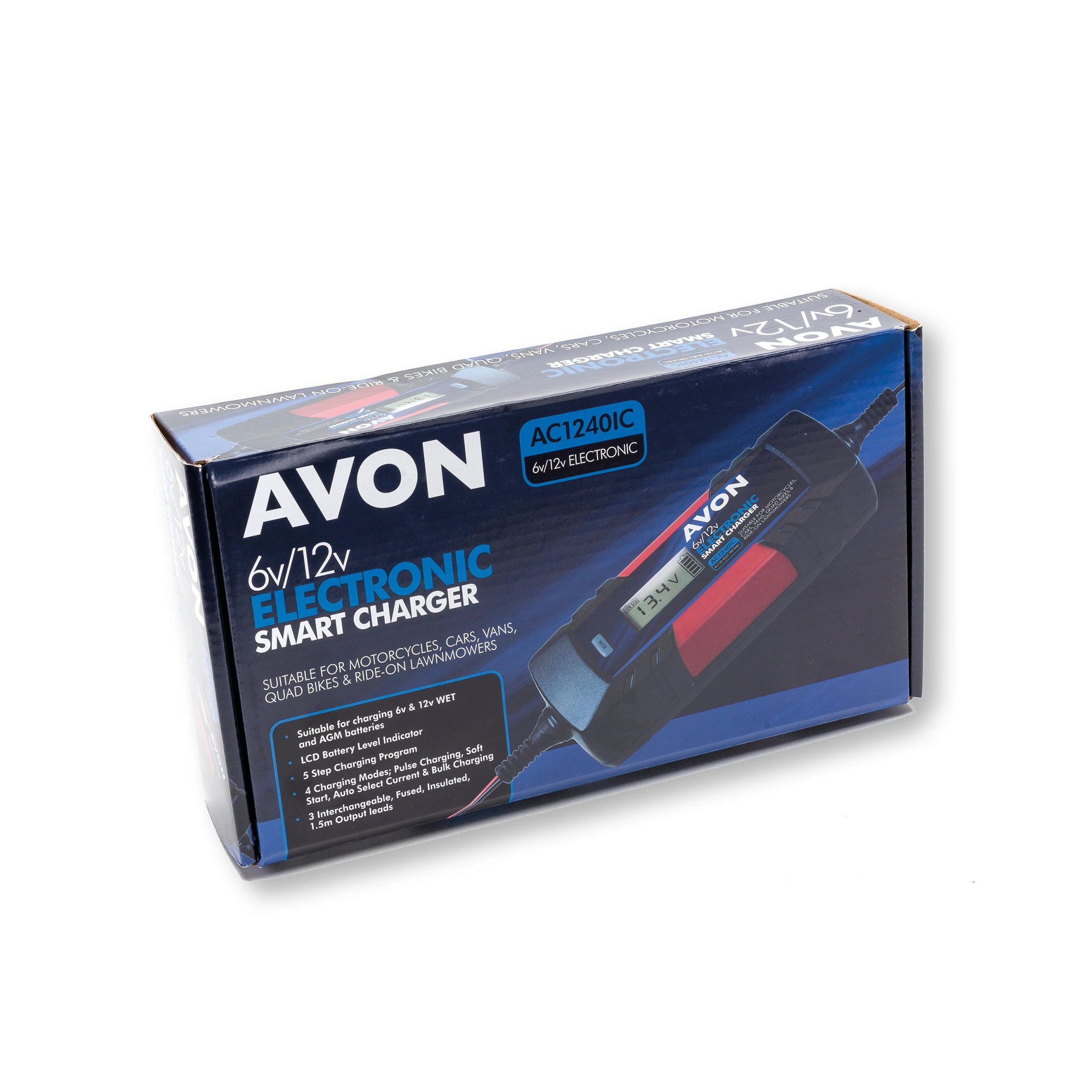
AC1240IC: 6V/12V 4A Intelligent
Ideal for caravanners who store their van for months at a time. The 5-step cycle covers diagnosis and recovery, soft start, bulk charging, absorption, and a float maintenance mode: so you can leave it connected all winter without risk of overcharging. Auto-detects 6V or 12V. Compatible with lead-acid, sealed, maintenance-free and AGM batteries 1.2Ah–120Ah.
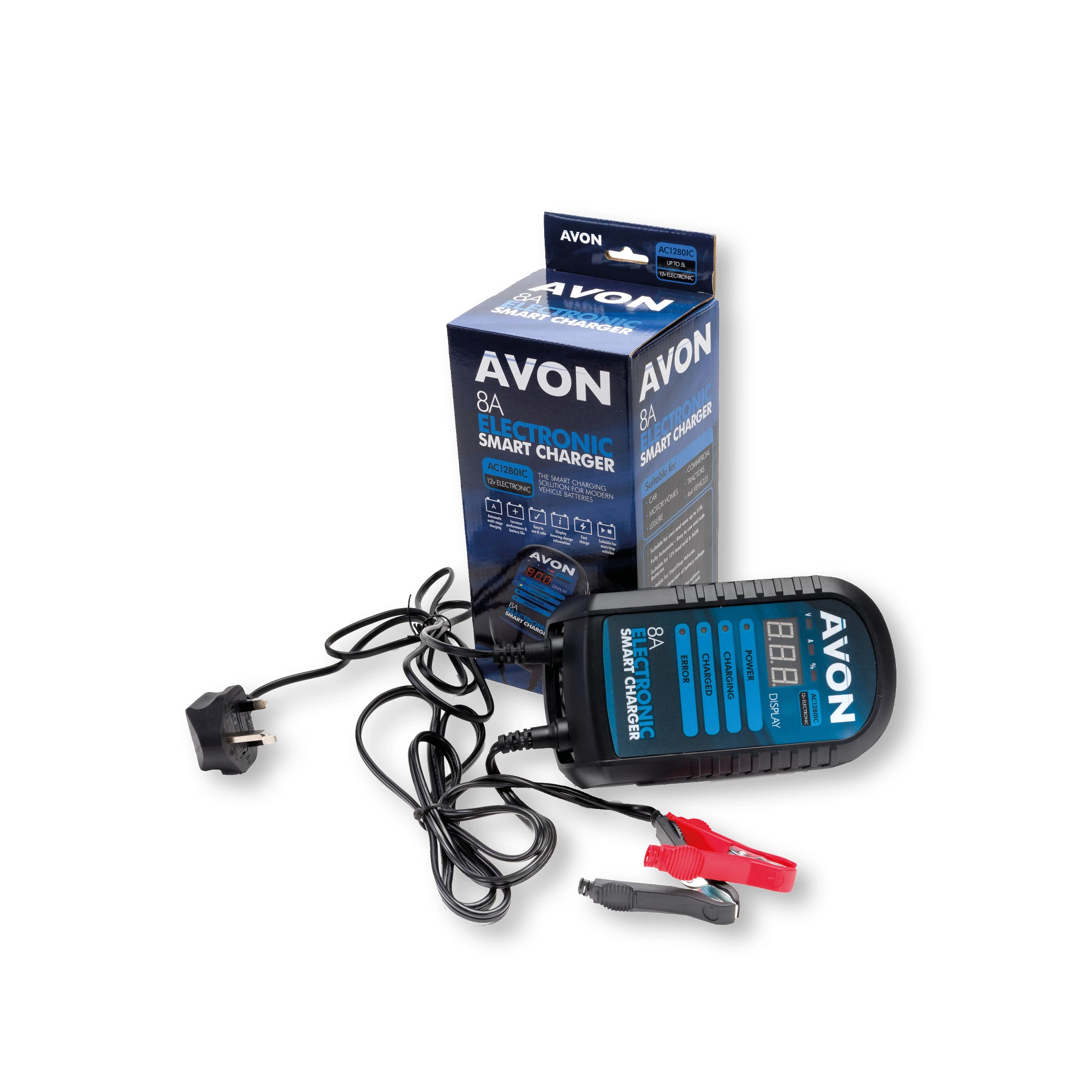
AC1280IC: 12V 8A Intelligent
The go-to choice for regular caravan and motorhome users. The 9-stage intelligent cycle detects battery voltage and condition before charging begins: including a reconditioning stage to recover mildly sulphated batteries. The 8A output means a 100Ah battery at 50% charge is typically recovered within 12 hours. IP65 rated. Suitable for lead-acid and AGM batteries 1.2Ah–192Ah.
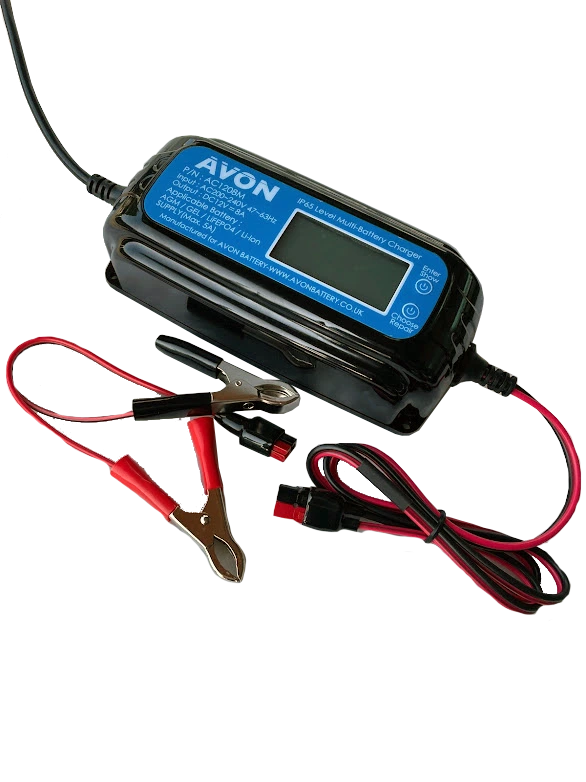
AC1208M: 12V 8A Multi-Selectable
The standout choice for users with mixed battery chemistry across different vehicles. Critically, this is the only charger in the AVON leisure range with a dedicated Lithium LiFePO4 charging mode (4-stage lithium programme) in addition to its 8-stage lead-acid/AGM cycle: a genuine differentiator for campervans increasingly running LiFePO4 setups. Selectable output of 2A, 4A or 8A. IP65 waterproof casing. Charges 12V lead-acid/AGM batteries 8Ah–100Ah and lithium batteries 4Ah–100Ah.

AC1220B: 12V 20A 5-Stage Intelligent
Recommended for motorhome owners with large battery banks who need faster recovery. The 5-stage intelligent profile includes an equaliser charge mode (prevents acid stratification) and a float mode for long-term maintenance. LED indicators for power, float and equaliser status. Digital meter shows charger status and battery level. Auto shutdown on fault. Suitable for larger leisure, marine and automotive batteries.
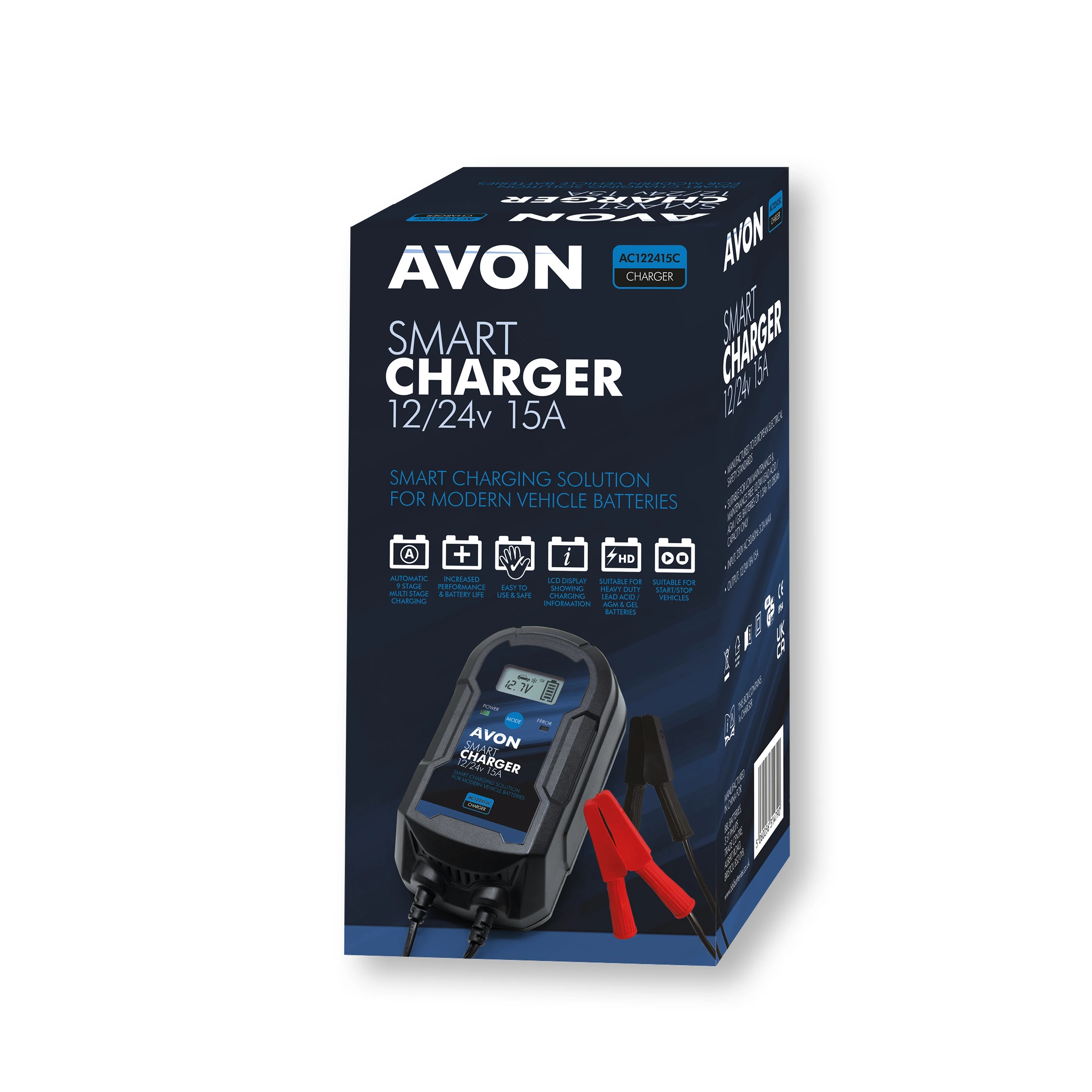
AC122415C: 12/24V 15A Intelligent
For 24V systems, twin battery setups, or any application requiring higher charge rates. The 9-stage fully automatic cycle includes 4 selectable charge rates and a winter charging option. 1.8m leads with insulated crocodile clips. Verified suitable for large cars, vans, motorhomes, boats, heavy vehicles and tractors. The professional-grade option in the AVON charger range.
Not sure which charger is right for your setup? Our team of battery specialists are available in-branch or by phone.
Types of Leisure Battery Charger Explained
Not all chargers are equal. Understanding the differences helps you avoid damage and get the most from every charge cycle.
Basic / Unregulated Chargers
These are now outdated and potentially damaging. Voltage can exceed 15V with no cut-off mechanism, which risks overcharging and gassing. Not recommended for leisure batteries under any circumstances.
Semi-Automatic Chargers
These cut off at a set voltage: typically 14.4V for low-maintenance batteries or 15.2V for standard types. An improvement over basic chargers, but not ideal for long-term or unattended connection.
Smart / Fully Automatic Multi-Stage Chargers
The recommended choice for leisure batteries. These chargers manage the full charge cycle automatically: including bulk (constant current), absorption (constant voltage), and float (maintenance) stages. Safe for permanent connection. This is what AVON’s IC range delivers.
Pulse Charging
A desulphation technique in which high-frequency DC pulses break down lead sulphate crystal build-up on battery plates. Often included as an early stage in quality multi-stage chargers such as the AVON AC1240IC and AC1280IC.
| Charge Stage | What Happens | When It Ends |
|---|---|---|
| 1. Diagnosis | Charger checks battery voltage and condition | Passes to next stage if battery is recoverable |
| 2. Soft Start | Low initial current to avoid shock to a flat battery | After short warm-up period |
| 3. Bulk / Constant Current | Maximum current pushes into battery until ~14.4V | When terminal voltage hits target |
| 4. Absorption / Constant Voltage | Voltage held steady, current naturally drops | When current drops to ~0.05C (e.g. 5A for 100Ah) |
| 5. Float / Maintenance | Voltage drops to ~13.6V, holds battery at 100% | Indefinitely: safe for permanent connection |
Charging Off-Grid: Solar, Generators & Alternators
For caravanners and campervan users away from mains power, there are several reliable methods for keeping your leisure battery charged.
Solar Charging
The most popular off-grid solution. A charge controller is essential to regulate voltage and prevent overcharging. There are two types: PWM (pulse width modulation) and MPPT (maximum power point tracking). MPPT is more efficient, achieving 90–95% charge levels compared to approximately 85% with PWM: and is significantly better in winter or low-light conditions.
We supply all the equipment you need for solar charging.
Car Alternator / Vehicle Charging
Good for topping up while driving, but not a complete charge solution. For caravanners, a relay-controlled second battery in the boot is a common approach. Speak to a qualified auto electrician for advice on your specific vehicle and setup.
Battery-to-Battery Chargers
Smart devices that redistribute charge from the starter battery to the leisure battery during driving. Compatible with all alternator types including stop-start systems and Euro 6 engines: where standard relay-based splitting can cause problems.
Portable Generators
A quick off-grid boost when needed. Connect via the onboard charger (230V socket) or direct 12V output. Allow the generator to stabilise before connecting to avoid voltage spikes damaging the charger.
Wind Power
Useful for coastal and exposed high-ground camping. Requires a voltage regulator, and excess power must be diverted into a resistive dump load to prevent over-speed damage to the turbine.
Maintaining Your Leisure Battery: Tips to Double Its Life
How you maintain a leisure battery between uses is just as important as how you charge it. Follow these expert tips to maximise battery life and avoid premature failure.
- Check the state of charge at least once a month, even in storage.
- Never discharge below 50% (12.2V): consider fitting a low-voltage cut-off relay to protect against accidental deep discharge.
- Recharge as soon as possible after use: sulphation begins within days of a deep discharge being left unaddressed.
- During long winter lay-ups, remove the battery from the van and charge with a dedicated leisure charger every 6–8 weeks.
- Store in a cool, dry location: never allow a discharged battery to freeze.
- Top up unsealed batteries using only distilled or de-ionised water. Tap water contains minerals that cause internal damage.
- Always ensure your charger is compatible with your battery chemistry. Using a charger with a desulphation mode on a lithium battery will cause permanent, irreversible damage.
Frequently Asked Questions
How long does it take to charge a leisure battery?
This depends on the charger output and the battery’s state of discharge. A 100Ah battery at 50% charge will take approximately 12–13 hours with an 8A charger, or around 6 hours with a 20A charger. Smart chargers such as the AVON AC1280IC automatically optimise charge speed through their multi-stage cycle.
Can I leave a leisure battery charger on all night?
Yes: provided you use a smart, fully automatic charger with a float or maintenance mode. These chargers, including the AVON AC1240IC and AC1280IC, automatically reduce output once the battery is full and can be left connected indefinitely without risk of overcharging.
What voltage should a fully charged 12V leisure battery read?
A fully charged 12V lead-acid leisure battery should read between 12.7V and above at rest, with no load applied and at least one hour after charging. A reading of 12.4V indicates approximately 50% charge: the recommended minimum before recharging.
What is the difference between a leisure battery and a car battery?
A leisure battery is designed to deliver a steady, low current over a long period and to be discharged and recharged repeatedly. A car battery is optimised for short, very high-current bursts to start the engine, then quickly recharged by the alternator. Using a car battery in a leisure application will significantly shorten its life.
Can you charge a leisure battery from a car?
You can top up a leisure battery by connecting it to a running vehicle via a relay that activates when the alternator is producing power. This is not a substitute for a full charge with a dedicated charger. For caravanners, a battery-to-battery charger is a safer and more effective long-term option.
How long does it take to charge a 100Ah leisure battery?
At 50% discharge, a leisure battery will take approximately 20–25 hours with a 4A charger, 6 hours with an 8A charger, or around 3 hours with a 20A charger. Charge times vary depending on the battery’s starting voltage, temperature, and the charger’s multi-stage profile.
Can I charge a leisure battery with solar panels?
Yes. Solar charging is a popular and effective off-grid solution, provided you use a charge controller to regulate voltage. An MPPT controller is recommended over PWM for greater efficiency, particularly in winter or low-light conditions: achieving 90–95% charge levels compared to approximately 85% for PWM.
Need help choosing the right leisure battery or charger for your caravan, motorhome or campervan? Our battery specialists are ready to help.


